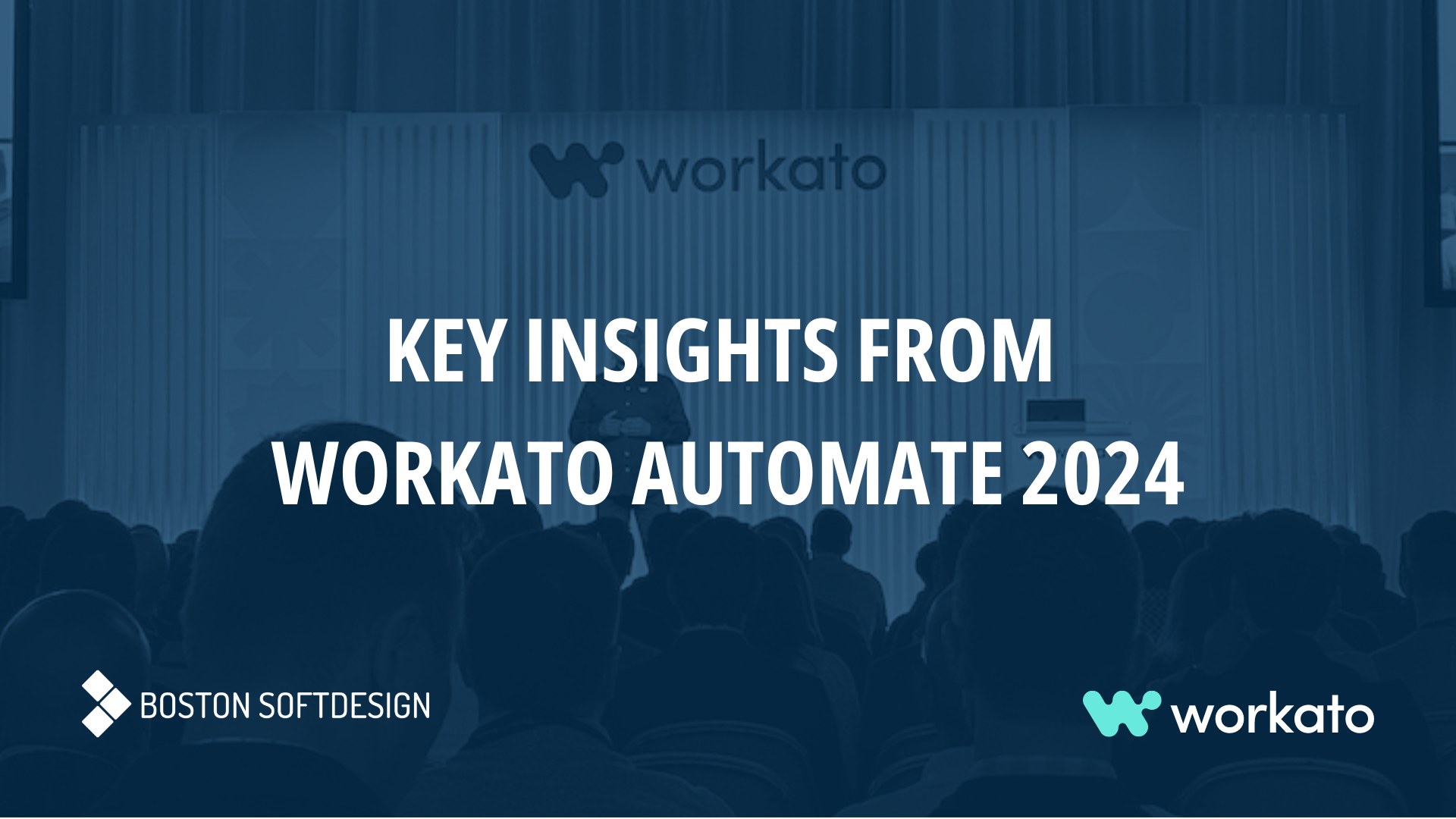
Workato Automate 2024, held in San Mateo, CA, brought IT professionals together to discuss the future of automation and AI. Boston SoftDesign proudly sponsored the event, participating in thought-provoking sessions and discussions. Read on to see our key takeaways, including enterprise orchestration and agentic AI.
Workato Automate is quickly becoming one of the top automation events in the industry. The 2024 event, held from August 13-15 in San Mateo, CA, was no exception, uniting leaders from Workato, Visa, Broadcom, Unity and more.
What’s more, Boston SoftDesign sponsored the event. So, we were there with all our swag and dressed in BSD gear as we talked, learned, and got inspired by the latest in enterprise automation.
Read on for our takeaways from the event. But, here’s what you really need to know: The agentic AI train is leaving the station, and it’s taking the productivity paradox with it.
Workato CEO: Enterprise Orchestration is the Future
Vijay Tella, CEO of Workato, kicked off the event with a keynote that covered major leaps for the company—and for the world of systems integration and automation as a whole. Tella explained that the way systems have been layered on top of each other over time has created a jigsaw puzzle for leaders who are looking to streamline and optimize.
Like Nostradamus, Tella clearly illustrated the challenge that large and complex organizations are facing today—and predicted that enterprise orchestration would rise to the occasion as the solution of the future.
“We’re waiting for the ‘iPhone’ moment in enterprise integration,” Tella said. “It’s not a replacement, but a harmonization, of the existing tech stack.”
The example Tella used was clever. Remember the late aughts? In 2008, you probably had a cellphone without mobile internet, an iPod for your music, a laptop for work, and a digital camera for documenting your life. Since then, all of these functions have been streamlined in modern iPhones and Android devices.
Tella pointed out that the explosion of cloud-based productivity tools has only led to greater disconnection and frustration, similar to someone trying to use their cellphone, iPod, laptop, and digital camera all at once. If these applications can be harmonized within enterprise systems, companies can finally bridge the gaps between experience, process, applications, and data that have long plagued their workers.
Another highlight of Tella’s speech was his focus on agentic AI. A recent CIO article broadly defines agentic AI as a technology that is “designed to automate a specific function within an organization’s myriad business processes, without human intervention.”
A great way to imagine agentic AI in your day-to-day is onboarding at a new job. Since agentic AI can cross-reference between systems, data, and processes, it makes the experience seamless for the end user. In this scenario, you’d be set up with onboarding, training, and provisioning automatically—all within the context of the larger onboarding workflow. The agent creates requests for you, follows the approval process step-by-step, provisions access, and keeps you updated with natural language interaction.
During the keynote, Tella presented Workato’s stake in this future, announcing its Workato Genie and Agentic Orchestration platform. By providing prebuilt genies and agents, they’re taking self-service to the next level cross-functionally, from IT to human resources to governance, compliance and procurement. We believe this is a huge step forward for Workato.
From Retrieval Augmented Generation to Agentic AI
Earlier this year, we wrote about retrieval augmented generation (RAG) architecture. AI tools as we know them today are trained on huge piles of data, enabling them to identify patterns and answer queries.
Unfortunately, most of the datasets used in generative AI tools like ChatGPT are just that—public—and aren’t trained on the nuances, compliance standards, or protocols of a large company. RAG solves this by allowing the AI tool to reach beyond the datasets it was trained on, generating more accurate and contextually relevant information for the user users.
Between RAG and what we learned at Workato Automate, we believe that this is an exciting time to work in systems integration. It’s as if we finally have the technology to solve our technology problems at scale—a need that has pained enterprise IT leaders for years.
Finally, we have strong and scalable iPaaS solutions for process orchestration. We can connect business systems, access all data sources across an organization, and act on that data within those business systems. What once seemed like a far-fetched dream has become a reality, and the result is the automation of business processes that improve decision-making, grant real-time visibility in performance, improve security, and make organizations more efficient overall.
Context-aware AI, that is AI tools that can be enriched with specific customer data or internal documentation, are the answer to the productivity paradox. Agentic AI peels back the layers of applications and data like an onion, fetching specific insights and acting on those insights instantly to streamline processes and optimize operations.
We’ve implemented several AI Workbot use cases with Workato’s Knowledge Bot accelerator architecture. But, we’re excited to see what comes next from Workato’s Enterprise Orchestration and Agentic AI platform.
To learn more about our Systems Integration and Automation capabilities, simply follow the link.